
MEN’S GROUPS
Where men learn to build the kind of brotherhood that changes lives.
In-person in Southern maine & online across maine + washington
A different kind of men’s work
No performance. No posturing. No clichés. My groups are spaces where men learn how to feel, tell the truth, hold each other to their best, and unlearn all the toxic conditioning that taught us to separate from each other.
These groups are the most powerful opportunity I offer. They’ve become communities of healing, accountability, emotional honesty, and real personal transformation. Many of my participants have expressed that connections with fellow group members have come to feel as close as, and in some cases even closer than, family.

Why men’s groups matter
A husband and father without deep connection to other men
is emotionally handicapped.
The medicine is connection
Men’s work isn’t about “fixing” you.
It’s about learning how to:
Stop doing life alone
Be seen and known in ways that most men never experience
Feel and express your emotional reality
Give and receive feedback
Regulate your nervous system with others
Stand in your truth without collapsing or attacking
Let other men support you
Build relational integrity and inner leadership
When men do this consistently, everything changes — relationships, intimacy, confidence, boundaries, purpose, emotional stability.
“A man with too much spine and not enough heart is a threat to love.
A man with too much heart and not enough spine is unreliable.
A man with a spine and heart in balance is a gift to the world.”

My Approach to Men’s Groups
Men come into these groups carrying years of unspoken fears, shame, anger, loneliness, confusion about masculinity, and longing for real connection. Most have never experienced a space where they can reveal all parts of themselves without being punished for it.
The framework I use:
Process vs. Support
While no group I offer is structured exactly the same, since no two groups of men are the same, there are some underlying principles that shape all of my groups. One of those principles is distinguishing between process and support.
Support groups are highly structured spaces designed for members to tell their stories and hear the stories of others. The focus and intention in support groups is to gain insight through shared experiences and hearing different perspectives for navigating life’s challenges.
Support groups can have a cozy feel to them, as they usually have a common focus that everyone can relate to — like alcoholism in the case of Alcoholics Anonymous.
Process groups are significantly less structured. The intention in a process group is to practice strict present-moment awareness and reveal one’s honest thoughts and feelings about other group members in real time. This allows for a depth of intimacy (and challenge) that is often missing in groups that are purely support focused. People give and receive hard truths, and group members get a lot of valuable feedback on how they impact others.
In my experience, both approaches offer something that the other doesn’t:
Support creates safety and familiarity: you’re not in this alone. Others get what you’re going through. You belong.
Process creates challenge and growth opportunities. It can be hard to face people’s honest opinions about you. In process, it’s very difficult to hide your wounds. You’ll be pushed to examine all the parts of yourself you avoid looking at. And you’ll learn how to challenge others in healthy ways, too.
Most of my groups are a blending of support and process.
The final ingredient
Somatic / Expressive work
The element that truly sets my groups apart is the use of specific techniques to express embodied emotion.
It’s one thing to say you’re angry… it’s another to express and release your anger through your body. In my groups, we don’t just talk about feelings, we learn to embody them.
All that pent-up emotional energy you’re carrying around in your body needs to go somewhere. With the proper tools, you can move those stuck emotions out of your system, and leave the group feeling light and free.
Whatever you need to let go of, we’ll hold it with you.
The work that shaped my groups
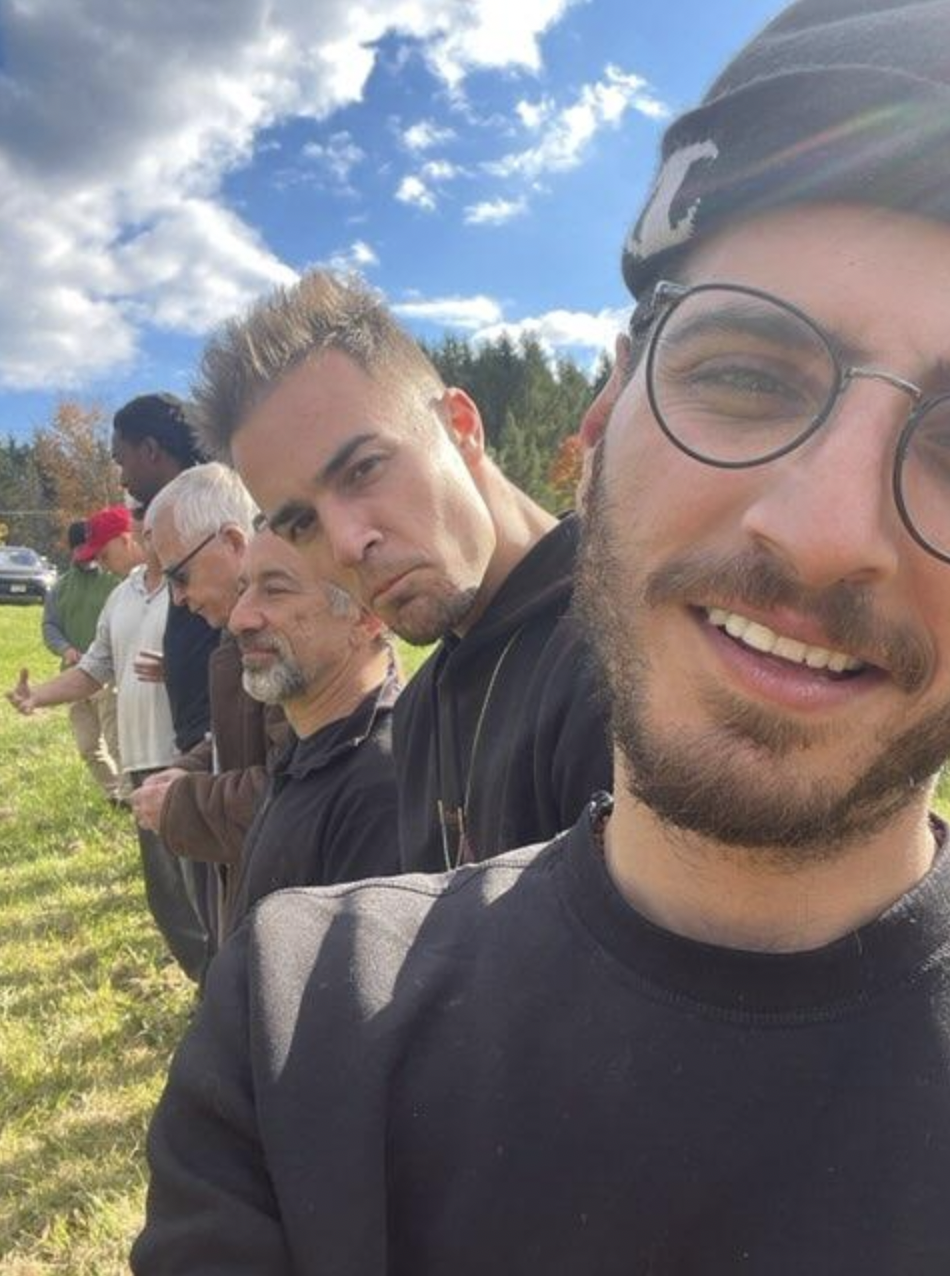
My men’s groups are deeply influenced by the circle work I’ve done inside prisons and community spaces. I’ve been part of — and trained inside — powerful healing initiatives that reveal what becomes possible when men drop their armor and face their demons head-on.
Some of the key influences from my lineage of men’s work include:
Facilitating men’s circles inside Maine State Prison through the Jericho Circle Project, learning firsthand how truth-telling and accountability can transform even the most hardened environments.
Staffing men’s retreats with All Kings, a nonprofit dedicated to helping men break patterns of isolation, emotional suppression, and generational trauma; recently featured in: The New York Times.
Ancestral healing work with James McLeary, former director of the Inside Circle Foundation — whose groundbreaking Folsom Prison documentary remains one of the most powerful depictions of men’s emotional transformation ever captured on film.
Other influences shaping my work:
Training in the Core Energetics lineage, a modality rooted in somatic truth-telling, emotional discharge, and embodied presence (the powerful Radical Aliveness Documentary captures this lineage beautifully).
Training in process group facilitation with the American Group Psychotherapy Association, whose GROUP video series offers a rare, unfiltered look into the mechanics of deep interpersonal work and relational healing.
These experiences taught me that community-based emotional work is some of the most powerful work a person can do — and that it can take many forms. My men’s groups are a living blend of these diverse traditions, lineages, and teachings.
Who These Groups Are For
Men who want deeper friendships and connection
Men who struggle with emotional expression
Men carrying shame, anger, loneliness, or confusion
Men who feel stuck despite previous therapy
Men wanting to heal childhood wounds in real-time relationship
Men dealing with compulsive behaviors, porn addiction, or low sense of meaning
Men who want to practice relational honesty and integrity
Men ready for accountability and real growth
Who These Groups Are Not For
Men looking for advice-only or surface-level support
Men unwilling to explore emotional or somatic experience
Men wanting traditional talk therapy
Men who are not ready to show up consistently
Current groups
Tues
6p - 7:30p EST
relationship support & process - in-person, southern MAINE
Status: 2 current openings
Wed
6:45p - 8p PST
porn addiction support & process - virtual/in-person hybrid, seattle area
Status: 2 current openings
FRI
7p - 8:30p EST
PRocess - virtual, multiple states
Status: 1 upcoming opening in Feb 2026
TBD
UPCOMING
porn addiction support & process
The format of this new group will be determined once a minimum number of participants has been established.
Status: Accepting interest / early enrollment

What Membership Looks Like
Each group includes:
Weekly sessions
A committed cohort
Group agreements around confidentiality, safety, honesty
Relational practice every week
Optional experiential somatic work
Opportunities for deeper individual work in the presence of the group
Community support between sessions (optional, depending on the group)
You’re not just learning — you’re training your capacity to stay present, speak truth, and feel more alive.

Ready to join one of my men’s groups?
the process:
A conversation.
A free 20-minute consult where you give me a brief overview of what’s going on and what you want from this work; I answer any questions you may have for me.A decision.
If it feels like a fit — on both sides — we’ll schedule your first session.A commitment.
From there, the real work starts.
No hoops. No performance. Just two humans seeing if we’re a good fit.
Click below to schedule a free consultation or inquire about openings.
Frequently Asked Questions
-
An initial commitment of 12 weeks is required.
-
No. These are not casual meet-ups, they are intentional spaces for deep emotional work.
If you’re joining a group that’s already established, you’ll be stepping into a close-knit community. Out of respect for the established group members, I don’t allow “drop-ins”.
In order to be eligible to join, you’ll need to be ready to put two feet in and give the group a real effort of 12 weeks’ participation.
-
My men’s groups range from $50-$80 per session depending on the group.
-
This depends on your readiness for group work. Many people find groups much more intimidating than individual therapy. If you are still new to the whole idea of opening up to people, you may want to start with individual therapy, and consider joining a group after building some trust and momentum with me first.
If, on the other hand, you’ve been to therapy before and are looking for an immediate step outside your comfort zone, joining a group straight away could be a good move.
I do also screen for “readiness”, as not everyone is truly ready for membership in a group right away. This is a conversation we can have together.
-
This is highly encouraged, as group and individual therapy can be very synergistic.
For those with significant time or money constraints, continuing individual therapy at a reduced frequency after joining a group is another option to make the most of the combination.
-
I bill for groups using a membership model, which is different from my billing for other services. Just like with a gym membership, you pay whether you use the gym or not. It is the same with the group. As long as you are a member of the group, you are billed for each session, whether you attend or not.
-
Many people have a history of negative associations with endings — best to get them over with as quickly as possible. Rip the bandaid off. Irish goodbye.
We don’t do this in men’s groups. Endings are just as important and meaningful as beginnings, so we don’t rush them.
Everyone joining a group agrees to give the group members a heads-up three sessions in advance of leaving the group. This gives everyone a chance to process the ending in a healthy and constructive way.
-
Traditional group therapy discourages socializing outside of the group, as this can sometimes interfere with the learning process in the group.
Sometimes I follow a traditional approach, sometimes I do not. Each of my groups has a slightly different policy depending on the unique needs of the group members and the particular structure of the group.
In some of my groups, the expectation is that you keep interactions with group members to the group only, and you do not build relationships with each other outside the group.
In other groups, you are welcome and even encouraged to build connections outside of the group setting.
I will make sure that the expectations are made clear to you, depending on which group you join.

Never give a sword to a man who won’t dance
-Chinese proverb